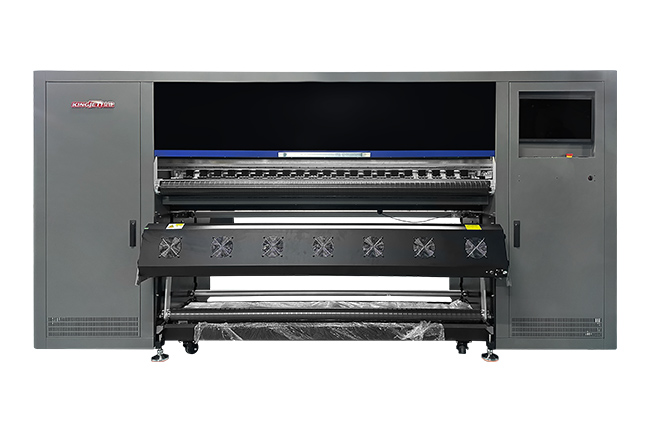
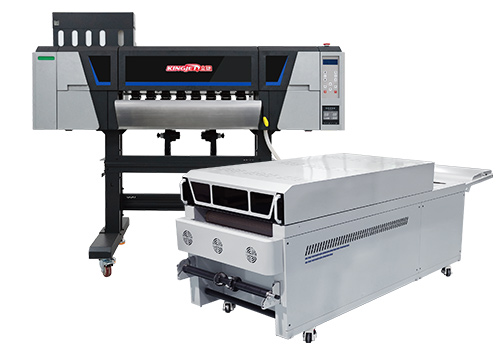
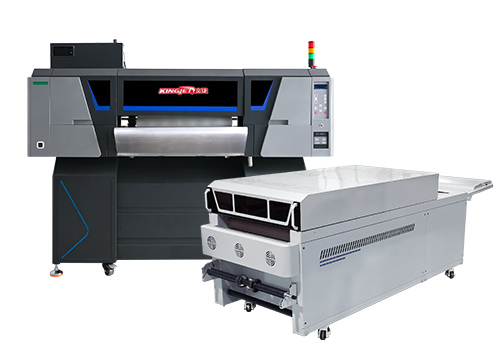
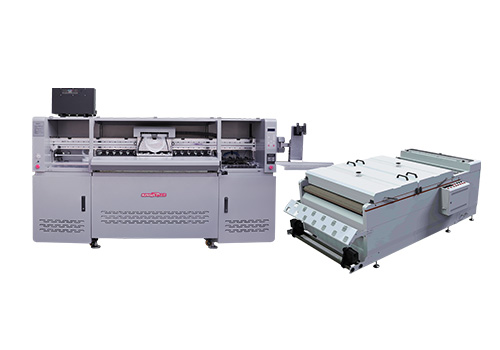
The KINGJET KJ-TX2000 is an industrial roll-to-roll direct-to-fabric printer built for textile producers handling different fibers, applications, and finishing routes. With a 1,950 mm print width, 24 EPSON S3200-A3-2 printheads, and a magnetic-levitation linear drive, it combines wide-format production, detailed image quality, and scalable output on one industrial platform.
Configured around pigment, reactive, acid, or disperse ink systems, the TX2000 helps manufacturers match the printing process to the fabric—not force every order through the same production route.
Key Features:
1.Four Ink-System Configurations
Configure the platform for pigment, reactive, acid, or disperse production according to the fabric, application, and finishing setup.
2.24 EPSON S3200-A3-2 Printheads
A dual-row 2 × 12 printhead layout balances industrial output with smooth gradients and accurate color reproduction.
3.1,950 mm Industrial Print Width
Designed for wide roll-to-roll textile production across apparel, home textiles, sportswear, flags, and other fabric applications.
4.Up to 15–20 m/min in High-Speed Mode
Supports short runs, rush orders, and fast-response production. Actual output varies with fabric thickness, print mode, ink coverage, and process requirements.
5.Controlled Fabric Transport
Active unwinding, dancer-roller tension feedback, fabric spreading, belt adhesion, and infrared belt correction keep wide fabrics flat and aligned through long runs.
6.Industrial Ink Management
Large-capacity ink supply, internal circulation, degassing, filtration, dual independent negative pressure, and temperature control support consistent ink delivery across 24 printheads.
7.Automated Belt and Printhead Care
Online belt washing, dewatering, and drying work together with automatic ink scraping, printhead cleaning, and moisturizing to prepare the system for the next production run.
Configuration Highlights:
*Actual production output depends on fabric thickness, print mode, ink coverage, ink system, and finishing requirements.
Match the ink and color setup to your fabric and orders.
Fabric, ink, motion, protection, and maintenance work together.
Support more fabrics, applications, and higher-value textile orders.
Send your fabric. Get the right process, configuration, and sample.
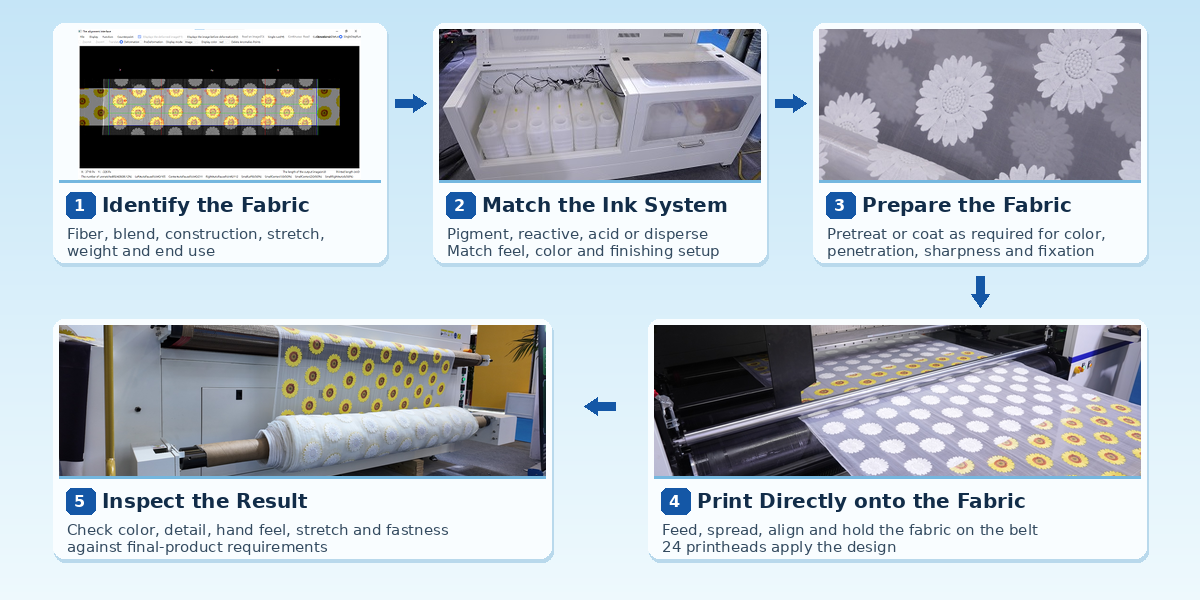
Different fibers require different ink chemistry and finishing routes. The TX2000 production process therefore starts with the fabric—not with a generic machine setting.
Step 1 — Identify the Fabric
Confirm the fiber content, blend ratio, fabric construction, stretch, weight, and finished-product application.
Step 2 — Match the Ink System
Select pigment, reactive, acid, or disperse according to the fiber, product requirements, hand feel, color expectations, and finishing setup.
Step 3 — Prepare the Fabric
Apply the required pretreatment or coating to control color development, penetration, sharpness, and fixation.
Step 4 — Print Directly onto the Fabric
The TX2000 feeds, spreads, aligns, and adheres the fabric to the belt while the 24-head printing system applies the design.
Step 5 — Inspect the Result
Evaluate color, detail, hand feel, stretch behavior, and fastness against the requirements of the final product.
| Product | Dual-row, 24-head S3200-A3-2 digital direct-to-fabric printer |
| Model | KJ-TX2000-S3200-24D |
| Printhead | EPSON S3200-A3-2 |
| Printhead Configuration | 24 printheads in 2 rows of 12 |
| Printing Method | Scanning |
| Printhead Height | 3–20 mm |
| Printing Speed | Output (m²/h) |
| Draft Mode | Up to approximately 600 m²/h |
| Speed Mode | Approximately 300 m²/h |
| Production Mode | Approximately 200 m²/h |
| Quality Mode | Approximately 150 m²/h |
| Max. Fabric Feed Width | 1,950 mm |
| Rated Print Width | 1,950 mm |
| Belt Width | 2,050 mm |
| Belt Depth | 2,100 mm |
| Ink Types | Reactive, pigment, acid or disperse ink |
| Color Options | 8, 10 or 12 colors |
| Fabric Types | Cotton, polyester, silk, nylon, Lycra, wool, linen and blends |
| RIP Software | neoStampa |
| Data Interface | Fiber optic |
| Power Supply | 380 V, three-phase |
| Machine Power | Approximately 12 kW (excluding dryer) |
| Dryer Power | Depends on the dryer model |
| Compressed Air Supply | Clean, dry air at ≥ 0.8 MPa |
| Recommended Ambient Temperature | 25–28 °C |
| Recommended Ambient Humidity | 60–70% |
| Machine Dimensions | 4,802 × 2,670 × 2,220 mm |
| Machine Weight | Approximately 3,000 kg |
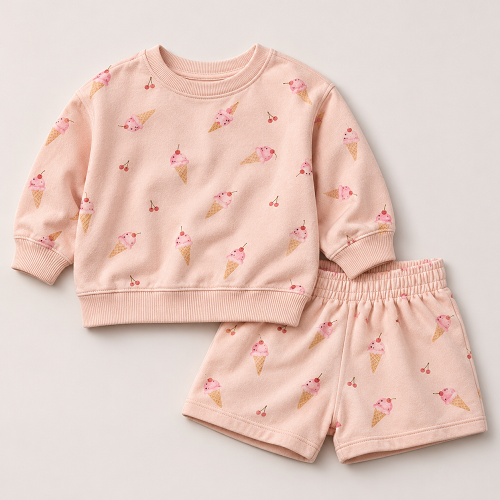
The KJ-TX2000 is built for textile manufacturers whose order mix spans different fibers, finished products, and production routes. From Denim and Kidswear to Carpets, and Swimwear—Expand the Range of Orders.
The TX2000 platform covers broad textile categories through pigment, reactive, acid, and disperse ink-system configurations. Cotton, linen, viscose, polyester, nylon, silk, wool, stretch fabrics, and blends require different ink chemistry and finishing routes, so the final configuration is matched to the target fabric and application.

The platform supports four ink-system configurations, but it should not be understood as instant ink switching during production. The machine and ink path are configured around the selected process. Any change between ink chemistries requires proper cleaning, process planning, and technical management.
Pigment printing offers broad multi-fiber coverage and is often the most practical route for blends. A combined dye process may be required for specialized color or performance requirements, depending on the exact fiber composition and finishing target.
The KJ-TX2000 provides a 1,950 mm printing width for wide roll-to-roll textile production. For finished products wider than the printing area, such as some curtains, bedding, or carpets, paneling and seaming should be planned before production.
High-speed mode can reach up to 15–20 meters per minute. Actual output depends on fabric thickness, print mode, image coverage, ink system, pretreatment, and finishing requirements.
Yes. Send your fabric and application requirements to request a process-matched sample showing the expected color, detail, hand feel, and fastness performance.
The TX2000 is designed around long-run production. Fabric correction, stable ink delivery, degassing, temperature control, board water cooling, collision protection, belt cleaning, and printhead maintenance work together to support continuous operation.
The standard pigment route uses pretreatment, printing, curing, and optional hand-feel finishing. It does not normally require steaming or post-washing, reducing workflow length and the need for heavy finishing equipment. Pigment is particularly relevant to blends, kidswear, denim, home textiles, POD, and one-off production.
Reactive printing is typically selected for cellulose fibers such as cotton, linen, and viscose when the order requires strong color, soft hand feel, and a complete steaming, washing, and setting process.
Acid printing is used for protein and polyamide fibers such as nylon, silk, and wool. Disperse printing is used for polyester. The process route should be selected according to the fiber, stretch, color, hand-feel, and fastness requirements.
The optional CCD system scans existing patterns and positioning points on embroidery, jacquard, lace, and other pre-formed or pre-patterned materials, helping the printer align color with the existing textile structure.
The machine combines independent board water cooling, a safety bottle against ink backflow, dual-side anti-collision, foreign-object detection, degassing, filtration, negative-pressure control, and automatic cleaning and moisturizing.
Comprehensive service starting from pre-sale to after-sale to help your business on track.
To show the quality and capability of our printer to satisfy your needs, we will send you a free video demonstration showing its operation. And you can get free samples for consumables.
To meet everyone’s order quickly, we have established branches in many places around the world, saving transportation time. Products in stock usually ship within 3-5 days.
You can enjoy one-year warranty on the main components of our brand machines, lifetime service for the entire machine operation, free after-sales consultation, and 24-48 hours technical support services.
In order to meet your various payment needs, we can accept many payment methods, such as TT, PayPal, credit card, letter of credit, western union, moneygram, etc.
We use cookies to provide you with the best possible experience. They also allow us to analyze user behavior in order to constantly improve the website for you.