
DTF vs Screen Printing: Which is Better for Your Textile Printing
Author : KingJet
2026-02-11
Whether you are a newcomer to the apparel printing industry, an experienced veteran, or someone preparing to enter this vibrant textile printing field, you have likely heard of the emerging DTF printing and traditional screen printing technologies. These two printing methods are widely used in the industry, but they differ significantly in operation and applicable scenarios.
This article will delve into these two printing processes, comparing DTF printing and screen printing from multiple dimensions to help you make a more informed choice for your textile printing business.
Table of Contents
What is DTF Printing?
DTF, short for Direct-to-Film printing, has emerged as a rapidly emerging printing technology in recent years. It involves printing designs directly onto specialized PET film, where the film’s surface coating facilitates pattern transfer. Finally, a heat press machine transfers the design onto garments or other textiles.
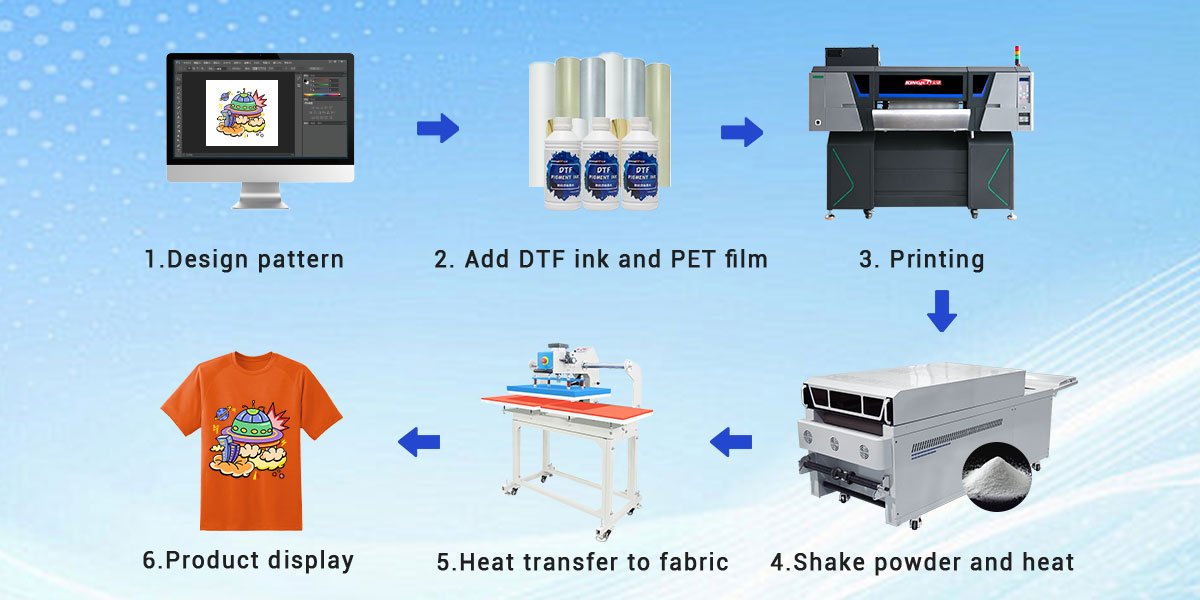
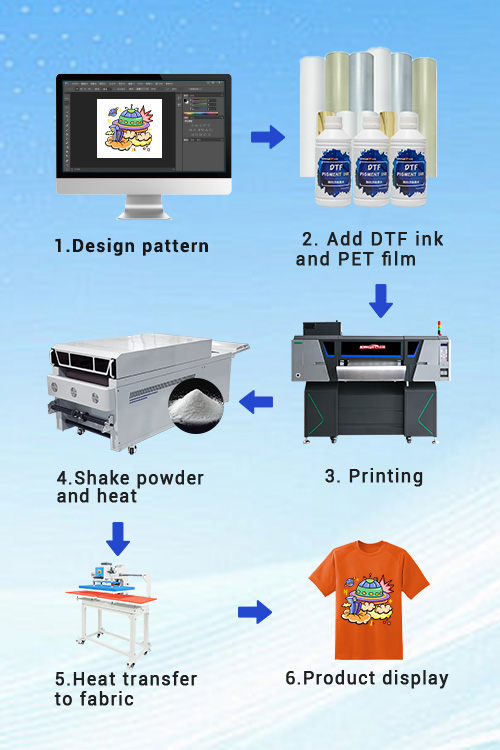
DTF Printing Process
1. Pattern Creation
First, create or prepare the pattern design using professional graphic design software.
2. DTF Printer Prints Design onto PET Film
The DTF printer prints the design onto transparent PET film, which has been specially coated to ensure water-based pigment ink adheres effectively.
3. Pattern Coating with Hot-Melt Powder
While the ink is still wet, evenly sprinkle a layer of DTF hot-melt powder over the printed design. This powder layer is crucial for securely bonding the design to textiles.
4. Drying and Curing
Heat the powder in an oven or drying machine to melt and stabilize it, preparing it for the subsequent transfer process.
5. DTF Heat Press Transfer
Cut the cured design and position it on the textile (such as T-shirts, sweatshirts, hats, etc.). Transfer the design permanently onto the fabric using a heat press at the appropriate temperature and pressure.
Applications of DTF Printing
Due to its high precision and flexibility, DTF printing technology is suitable for a wide range of fabric types, including but not limited to:
Cotton
Polyester
Blended fabrics
Dark fabrics
And more…
Pros and Cons of DTF Printing
Pros of DTF Printing
No Plate Making or Minimum Order Quantity: Eliminates the need for printing plates, enabling quick turnaround and single-item printing, making it ideal for on-demand production.
High-Quality Printing: DTF printing produces vibrant, richly colored prints with exceptional color accuracy.
Wide Material Compatibility: Whether it’s natural fibers (such as pure cotton) or synthetic fibers (such as polyester, blended fabrics, nylon, etc.), DTF printers can handle them with ease.
Strong Detail Processing Capability: Capable of reproducing fine lines, gradients, and intricate designs.
Durability: With proper care, DTF-printed images withstand over 50 washes without fading or cracking.
Eco-Friendly: Compared to traditional printing methods, DTF generates less waste and primarily uses water-based pigment inks, making it more environmentally sustainable.
Cons of DTF Printing
Slightly Higher Initial Investment: Requires the purchase of specialized DTF printers, PET film, DTF adhesive powder, heat press machines, etc., making the initial cost slightly higher compared to other printing machines.
Equipment and Technical Requirements: Requires investment in a specialized DTF printer, DTF powder, dryer, and heat press machine, as well as basic equipment maintenance knowledge.
Unique Feel: The printed layer forms a soft, adhesive-like feel.
What is Screen Printing?
Screen printing is a traditional process that uses a screen to transfer ink onto a substrate. Each color requires a separate screen, and the ink is transferred to the fabric through the mesh using pressure from a squeegee.
Screen Printing Process
1. Color Separation and Plate Making
First, create the design and separate it into distinct color layers. Each color requires a separate screen.
2. Screen Mounting and Registration
Mount the screens onto the printing press and precisely align them.
3. Ink Application and Squeegee Printing
Pour ink onto the screen. Using a squeegee at a specific angle and pressure, force the ink through the mesh onto the fabric below.
4. Flash Curing Between Colors
After printing one color, flash curing equipment is typically used to rapidly solidify the surface before printing the next color, preventing color mixing.
5. Final Curing
After all colors are printed, a tunnel oven is used for thorough curing, permanently bonding the ink to the fibers.
Applications of Screen Printing
Due to its thick ink layer, unique texture effects, and large-scale production capabilities, screen printing is widely used on the following fabrics and apparel:
Fabrics: Cotton, polyester, and other common plain knit or woven fabrics produce the best results.
Apparel Types: T-shirts, promotional shirts, sportswear, etc.
Order Types: Large-volume orders with stable designs and a limited number of colors (such as corporate uniforms, event attire).
Pros and Cons of Screen Printing
Pros of Screen Printing
Thick and Durable Ink Layers: Screen printing produces thicker ink layers, resulting in more durable designs that withstand significant pressure.
Ideal for High-Volume Production: Screen printing is highly efficient and cost-effective for large orders requiring identical designs.
Vibrant Colors: For solid-color designs, screen printing achieves exceptionally vivid color effects.
Material Versatility: Beyond fabrics, screen printing is suitable for a wide range of other materials.
Cons of Screen Printing
Color Limitations: Each color requires a separate screen, making small-batch, multi-color orders costly and inefficient.
Environmental Concerns: Conventional plastisol inks may pollute the environment if improperly handled.
Design Limitations: Not well-suited to complex images such as color gradients or photographic prints. More colors increase complexity and cost.
Lack of Flexibility: Design changes require new screens, making it unsuitable for fast-response production with frequent style changes.
Detailed Comparison of DTF Printing and Screen Printing
DTF printing and screen printing differ significantly in printing methods, production speed, color brightness, material flexibility, durability, and cost.
| Printer Type | DTF Printing | Screen Printing |
| Printing Process | print – shake powder – dry – transfer | plate making – setup – print – cure |
| Production Speed | fast, suitable for small batches | Best for large volumes, complex setup |
| Operational Complexity | simple operation, easy to learn | complex operation requires skill |
| Feel and Breathability | Soft but with a film-like feel | Lightweight, breathable, no adhesive feel |
| Quality and Precision | High precision, handles intricate designs | Suitable for simple patterns, thick ink layers |
| Color | Rich and delicate colors can print gradient colors | High brightness for solid colors |
| Fabric Flexibility | Adaptable to diverse fabrics: cotton, polyester, blends, nylon, and some non-wovens. | Optimal on natural fibres; challenging on synthetics/stretch fabrics |
| Durability | Large patterns may crack after repeated washing | High |
| Cost | High initial investment, long-term benefits | Low initial investment, reduced per-unit cost |
| Environmental impact | Relatively more eco-friendly | Less environmentally friendly |
| Applications | Personalized customization, rapid printing | Mass production, low-cost production. |
Choose the Right Printing Method for Your Textile Printing Business
Choosing between DTF printing and screen printing depends on your specific business needs, budget, and long-term goals. Here are some factors to consider:
Order Volume
If you primarily handle small-batch, high-variety orders, DTF printing may be more suitable. For those targeting high-volume production markets, screen printing can be more cost-effective.
Design Complexity
DTF printing offers superior precision and detail handling for designs featuring intricate multi-color gradients or fine lines. For bold solid-color patterns or simple line art, screen printing may suffice.
Fabric Type
Consider your primary fabric types. DTF printing offers broader fabric compatibility, while screen printing may perform better on certain traditional cotton fabrics.
Budget and Long-Term Goals
Evaluate your initial investment capacity and long-term business objectives. DTF printing, though slightly higher upfront, may provide greater flexibility and cost-effectiveness over time. Screen printing is better suited for businesses with established, stable, high-volume production processes.
Conclusion
The choice of textile printing technology depends on your business needs, budget, and long-term goals. DTF’s advantages lie in its versatility and design complexity, while screen printing remains the preferred choice for high-volume printing and durability (repeated washing).
To learn more about the differences between DTF printing and screen printing, please consult the professional KingJet team with 18 years of experience in the printer industry. We will provide you with exclusive services. Contact Us Now
FAQ
How many washes can DTF-printed images withstand?
With proper care, DTF-printed images typically withstand over 50 washes without significant fading or cracking. However, the exact number of washes depends on the fabric type, washing method, and maintenance practices.
Which is more suitable for beginners: DTF printing or screen printing?
For beginners, DTF printing may be easier to learn because its setup process is relatively simple and it can handle a variety of materials and design types. However, while screen printing has a steeper initial learning curve, once mastered, it is highly efficient for mass production.
Which is more environmentally friendly: DTF printing or screen printing?
DTF printing has certain advantages in terms of environmental friendliness because it generates less waste and uses mostly water-based inks. However, screen printing is constantly being improved, adopting more environmentally friendly inks and materials to reduce its environmental impact.